


Page 31 - GUIDO RENI 2017
P. 31
That the Country Dance was executed early in Reni’s

career is self-evident since there are echoes of Ludovico

Carracci and even of Annibale. In Emilia the tradition

of the concert party or Fête Champêtre as a subject

derived, of course, from Niccolò del Abate and some

of the more elegant, aristocratic figures in Guido’s

composition, both in their dress and poses, closely echo

Niccolò. For instance, the seated lady in red to the left as

well as the central figure looking out at us who is invited

to the dance, both resemble Niccolò dell’ Abate’s Alcina

receives Ruggero (Bologna, Pinacoteca Nazionale) and his

various concert parties in the Biblioteca Universitaria

in Bologna. Niccolò dell’ Abate’s maniera was later

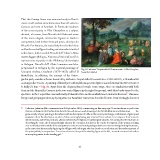
perpetuated in Bologna by the mystical paintings of           Fig. 8. Ludovico Toeput called Il Pozzoserrato. A Fête Champêtre,
Giovanni Andrea Donducci (1575–1655) called Il                Swiss Art Market.

Mastelletta. In addition, the concept of the festive

garden party was also a theme favoured by Ludovico Toeput called Pozzoserrato c.1550-1603/5, a Flemish artist

working in the Veneto. A painting of this subject with stylish cinquecento figures was sold in Basel in 2016 ( Beurret

& Bailly 22 June – Fig. 8). Apart from the elegant plumed couple centre stage, there are similarities with both

Reni and the Marseilles Carracci in the two seated figures in the right foreground, with their backs turned to the
spectator. In the Toeput there is a uniformity of class structure and dress which is not evident in the Reni7. This same

foreground grouping is taken up by Agostino (or Annibale) Carracci as described below. Reni’s lovingly observed

7.	 Catherine Johnston (Ms. communication 20 September 2016) commenting on this essay says ‘Guercino shows to perfection
     this mix of classes in the Emilian hinterland in his well-known wash drawings in the British Museum and Ashmolean…… the
     great novelty of your painting is the subject with its description of a fête in the country involving a combination of gentry and
     peasants in their Sunday best, a number of them seemingly having just returned from a shoot. It is unique in Reni’s oeuvre
     which consists, aside from portraits, almost exclusively of religious or mythological subjects. It is unexpected for its charm in
     describing the event, the detail and delight taken in the costumes, but also for the tender description of the woman reaching
     over to the baby in the middle of the composition or the one to the side guiding a child over a narrow bridge fording the stream,
     at the same time humorously depicting the villager with red braghe who has drunk too much wine and the embarrassment of
     the principal lady’s companions. I’m not sure how to interpret the standing figure at the left, as much a steward or brother
     as an aspiring swain to the standing girl.’

31

