


Page 28 - GUIDO RENI 2017
P. 28
Thus one might assume that the Guercino drawing
                                                may represent a marriage procession on its way to
                                                the church on the hill. Guercino’s palette is also quite
                                                different and his brushwork flatter. We know from a
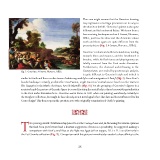
                                                few surviving landscapes such as A Concert, Florence,
                                                Uffizi, just how his skies and the chromatic values
                                                work and these again are quite different from the
                                                present picture (Fig. 3 A Concert, Florence, Uffizi).

                                                Guercino’s colours are both more tenebrous, tending

                                                towards blues and mauves, and the brushwork is

                                                broader, while his flesh tones and physiognomy are

                                                totally removed from the Reni under discussion.

                                                Furthermore, the charcoal underdrawing in the

Fig. 3. Guercino, A Concert, Florence, Uffizi.  Country Dance, as revealed by spectroscopic analysis,
                                                is quite different to Guercino’s style and indeed is

similar to Guido and there are also traces of what may possibly be read as a signature G.Reni f. (Fig. 4). Since Reni’s

bucolic landscape certainly predates the Casa Paninni, might Guercino’s initial source have been the Carracci

Fête Champêtre in the Musée des Beaux-Arts de Marseille (Fig. 10) Yet the grouping of Guercino’s figures in a

semicircle and the posture of the male figure (reversed) inviting the seated lady to dance bears striking similarities

to the Reni under discussion here. Guercino was in Rome in 1621 when our painting was already certainly in

the Borghese collection, but might he have already seen it in Bologna before that date and been influenced for his

Cento design? This then reopens the question as to who originally commissioned Guido’s painting.

T wo years ago Keith Christiansen happened to see the Country Dance and, in discussing the various opinions
        that had been put forward and a hesitant suggestion of Reni as a possibility, he suggested making a
        comparison with Reni’s small Rest on the Flight into Egypt (oil on copper, 28.5 x 21.5 cm) formerly in
the Pat Coombs collection (Fig. 5). Comparison with this picture immediately revealed a close affinity to the

                                                  28

