
Achille Benouville
Place Born
ParisPlace Died
ParisBio
The elder brother of the history painter Léon Benouville (1821-1859), the young Achille first entered the studio of the renowned academic master François Edoard Picot (who numbered among his many pupils Bouguereau as well as Achilles younger brother Léon). Despite the emphasis on figure painting in his masters studio, Achille concentrated on landscape, particularly views from nature in the Paris region executed in oils and watercolor. Encouraged by Picot, Benouville won the 2nd prize in the 1837 Prix de Rome historical landscape concours. He had already exhibited at the Salons, having made his debut in 1834, but although he made two brief trips to Italy in 1838 and 1840, it was not until after a third, longer journey (in the company of Corot), in 1843 that he began to make use of the sketches done there in his large scale works. In 1845 he won the first Prix de Rome, with a Ulysees and Nausicaa which gave him an opportunity to make a fourth Italian trip, but this time at the expense of the State. Travelling with his brother Léon, who had won the first prize for history painting that same year, Benouville remained in Italy for the next thirty-one years with only brief trips back to the country of his birth. With the death of his wife in 1870 he left Italy forever, however, returning to France the following year. He eventually remarried but confined his travels to the French provinces and permanently established his studio in Paris.
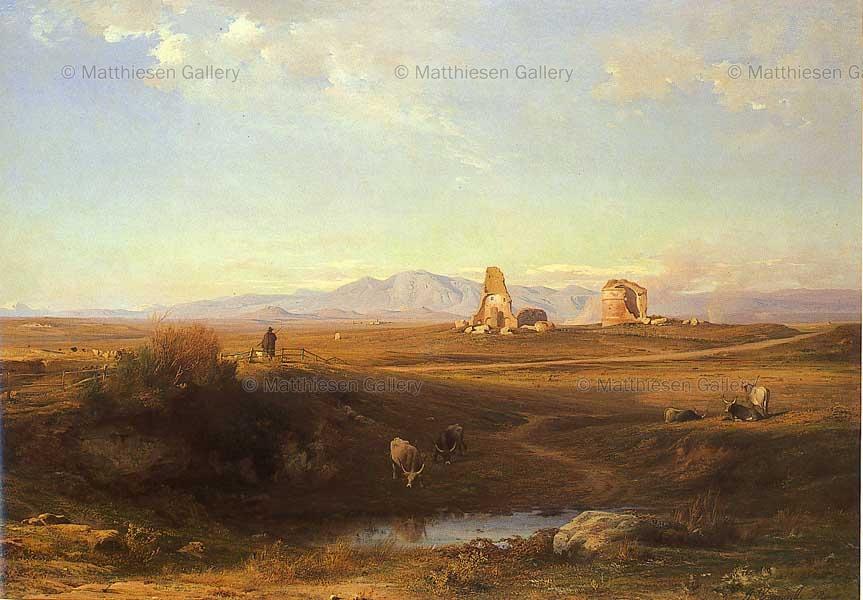
Benouville was one of the French painters of this generation (he was a near contemporary of Harpignies, just four years his junior) most influenced by Italy and, although he eventually abandoned history painting, his early ambition was to follow the example of Valenciennes. The figures in his paintings and his surviving watercolors amply demonstrate his skills but they are nonetheless generally subordinated to the landscape. His exhibited works from the early 1840s include large scale subjects such as Homer abandoned in the Island of Chios greeted by the shepherds (shown at the Salon of 1843 Saumur, Musée des Arts Décoratifs) and his prize winning Ulsses and Nausicaa (Paris, école des Beaux Arts). By the late 1840s, however, Benouville had virtually abandoned the paysage historique, presenting two large topographical works at the 1848 Salon, the Chigi Park at Ariccia near Rome (location unknown) and Lungezza near Rome (exhibited here). A series of large scale works followed: the Banks of the River Anio near Tivoli (Salon of 1850, Reims, Musée Saint Denis), View near Ariccia (1850 Salon, location unknown), Italian Landscape (Rouen, Musee des Beaux Arts), and A Ravine (1870 Salon, Paris, Nouvel Opéra, Salon des Glaciers). In the last years of his life Benouville abandoned his large scale canvases for more modest works but, while clearly aware of the developments initiated by Courbet, he remained immune to their consequences, his style firmly entrenched in the conventions of the first half of the century.
Art Works Sold Or Not Available
Sold or not Available