
The Campagna at Lungezza near Rome(Achille Benouville)
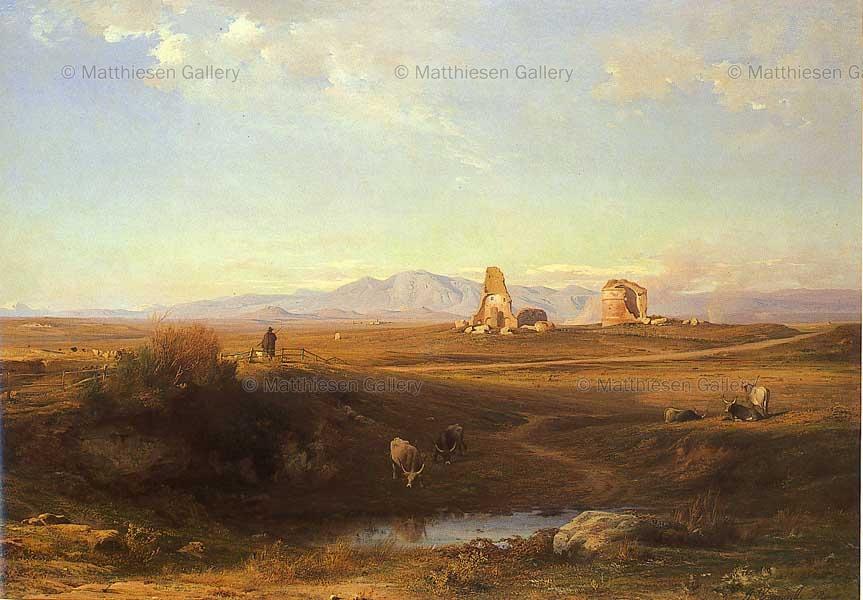
In this ambitious Roman panorama Benouville was evidently hoping to measure up to Vicomte René de Châteaubriands description: There is nothing comparable in beauty to the lines of the Roman horizon, to the gentle slope of its planes, to the soft, receding contours of the mountains by which it is bound. The valleys in the Campagna often take the form of an arena, a circus, a hippodrome; the hills are carved like terraces, as if the mighty hand of the Romans had moved all this earth. A extraordinary haze envelopes the distance, softening objects and concealing anything that is harsh or discordant in their forms. Shadows are never heavy and black; no mass of rock of foliage is so obscure that a little light does not always penetrate. A singularly harmonious tint united earth, sky and water: all surfaces, by means of an imperceptible gradation of colors, coalesce into their extremes without one being able to determine the point at which one nuance ends or where the other begins.
Here the plain recedes towards a distant blue-gray tinged mountain range, silhouetted against the horizon. Its ridges and gullies are emphasized by the acute angle of the sun, which marks out a small rise in the foreground, on which a lone shepherd stands looking back at his flock. Nearer, sheltering from the heat, two horned cattle are grazing, moving slowly towards a water hole while their companions can be seen on the right of the composition. The painting is dominated by the ruins of an ancient building and beyond, barely visible, we can glimpse what may be a country villa or a small hamlet.
Paris, Salon, 1848, no.