
Paul Cézanne
Place Born
Aix-en-ProvencePlace Died
Aix-en-ProvenceBio
Cezannes father was a successful manufacturer of hats who, in 1847, was sufficiently well off to acquire a local bank, founding the Banque Cézanne et Cabassol. Paul and his sister Marie were born several years before their father married their mother, Honorine, a former factory worker who had become his mistress, in 1844.
As a young man Cézanne met the writer Emile Zola and the two remained friends until falling out some twenty years later. Cézanne graduated with honors from the Collége Bourbon while also learning drawing at the Aix école de Dessin, winning a second prize in 1858. When Zola left to go to the Sorbonne, Cézanne followed him to Paris to study painting as soon as his father allowed. At the Académie Suisse Cézanne met Guillaumin and Pissarro but failed to gain entrance to the école des Beaux-Arts. Discouraged, he returned to Aix to work in his fathers bank. He never abandoned his hope of becoming an artist, however, taking up drawing lessons and beginning work on his early Four Seasons. In 1862 he returned to Paris to recommence his studies at the Académie Suisse, alongside Pissarro, Guillaumin, Bazille, Monet, Sisley and Renoir. He accompanied Zola to the 1863 Salon des Refusés where he was particularly struck by the work of Courbet.
1862 marked a distinct change in Cézannes style; he began to paint portraits and figurative erotic subjects, and while his compositions clearly owed something to the romantics he also began to employ caricature, as in the Portrait of Valabrégue. His paintings were regularly refused at the Salon, however, and his disappointment led him to return home to Aix once again in 1864, remaining there until 1870 when he began dividing his time between Aix and Paris. Living an unstable existence in the capital, where he constantly changed apartments and began a relationship with his future wife Hortense, a young model, Cézanne began to paint in a style inspired by Tintoretto, Magnasco, Crespi and Goya with whose work he had become familiar during visits to the Louvre.
In 1872 Cézanne joined Pissarro in Pontoise, a trip that proved a turning point in his career. After a brief separation, he again met up with Pissarro in Auvers-sur-Oise where he remained for two years, close to Dr Gachet and his new friend Van Gogh. Like the latter he worked en plein air whenever possible but, unlike Van Gogh, managed to slowly build up a modest clientele for his work. Though he declined to exhibit in the second impressionist show he included seventeen still lifes and landscapes in the third. Having fallen out with both his father, who disapproved of his career and of his cohabitation with Hortense (whom Cézanne finally married in 1886), he then quarreled with his boyhood friend Emile Zola. Deprived of his fathers allowance and the comfort of his old friendship with Zola (with whom he broke completely after the writer published his critique of the Impressionists in Loeuvre), Cézanne gained a reputation for irritability and his friends began to avoid him. His moods became worse when he developed diabetes in 1891.
In 1882 he had the satisfaction of finally being accepted at the Salon, as a student of Guillemet, but he continued to spend most of his time in Provence with occasional trips to join his friends such as Monet and Renoir. The 1890s marked his greatest period of production, including the series of portraits of Mme Cézanne, Bathers and Mont Saint Victoire, adopting a more spatial and geometrical style that concentrates on color and its contrast. In 1899 he exhibited at the Salon des Independants and, in 1900, he was invited to show at the Centennial Exhibition where the National Gallery of Berlin purchased one of the artists landscapes. The death of Zola in 1892 deeply affected him, his great success and many official honors providing little consolation. By the time he died in 1906 his early disappointments were forgotten, however, his critical reputation was established and he had finally achieved the fame that had eluded him for so long.
Art Works Sold Or Not Available
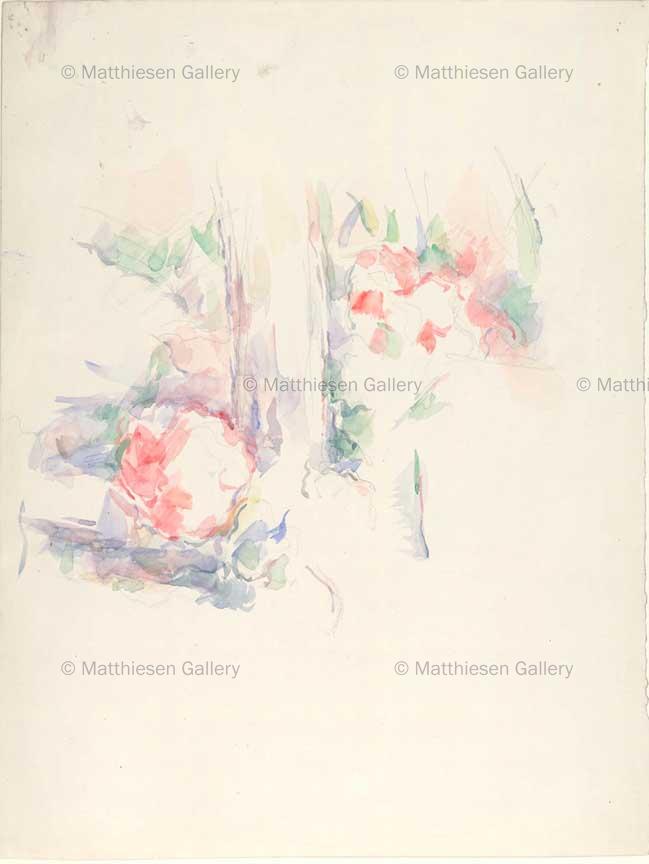
Sold or not Available