
Spring Flowers(Henri Fantin-Latour)
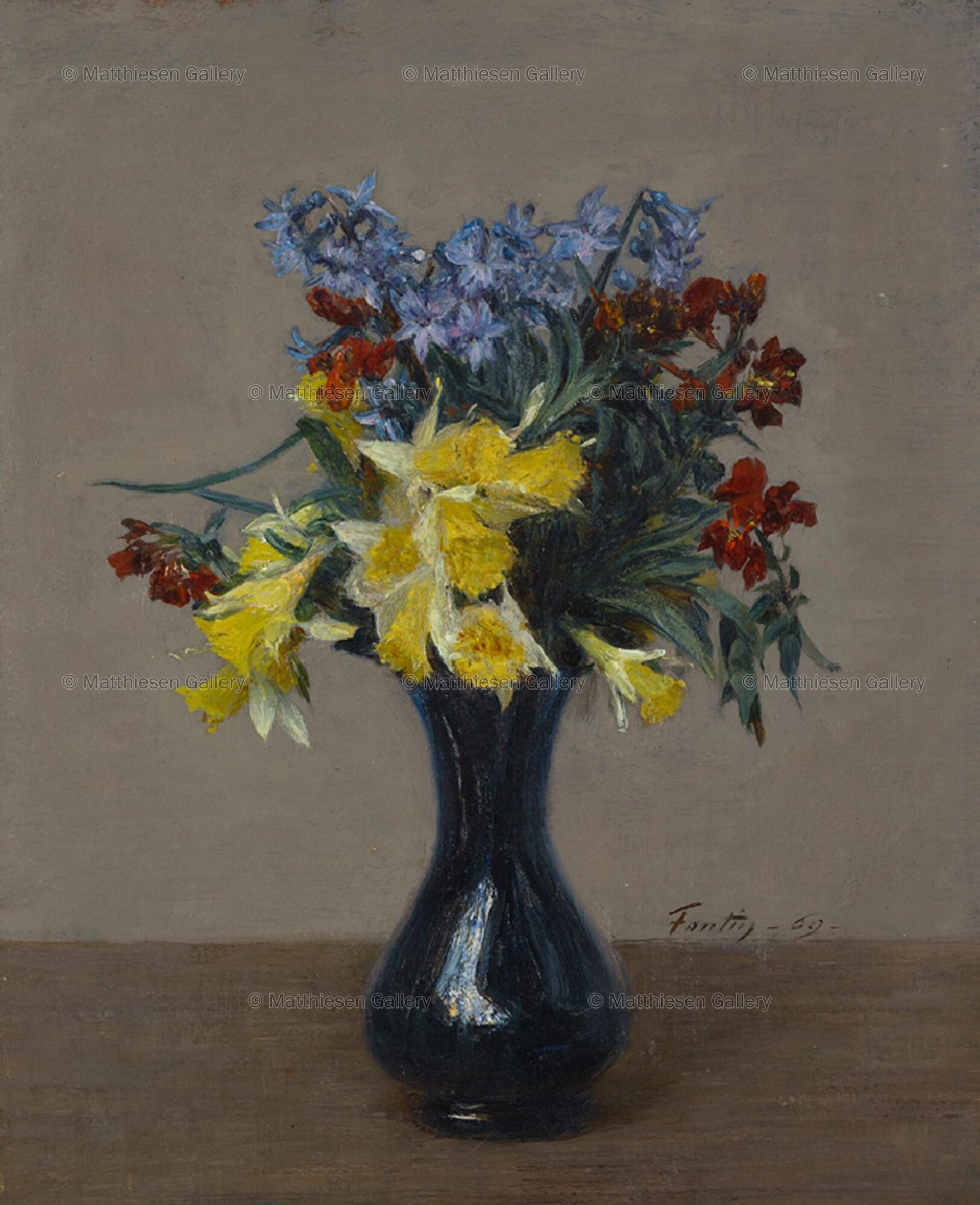
It was relatively early in his career that Fantin-Latour turned away from portraiture in favour of still life, although the four group portraits of artists, writers and musicians painted in 1865, 1870, 1872 and 1884 (all four now in the musée d’Orsay) probably remain his greatest artistic achievements. This shift in subject matter allowed Fantin-Latour new scope for experimentation with colour, texture, form and composition. It was on the basis of these flower pieces, and thanks to his friendship with Whistler’s brother-in-law, the surgeon and artist Sir Francis Hayden, and the patronage of English collectors and dealers, that Fantin-Latour achieved contemporary acclaim. The financial support afforded by his commercial success offered the artist the freedom to dedicate himself to the academic exploration of his craft. This was later exemplified by his fascination with musical themes, painting subject from the music of Wagner, Bizet and Brahms, and experimentation with lithography.
The present work, a casually assembled bunch of narcissi (Narcissus pseudonarcissus), English bluebells (hyacinthoides non-scripta) and wall-flowers (Erysimum cheiri) placed in an elegant blue glass vase, demonstrates Fantin-Latour’s technical ambition and the liberty of focus afforded by professional security. Fantin-Latour conjures leaves and petals with a lightness of touch and sensitive brush, on a canvas textured with softly layered impasto – while always respectful of conservative artistic practice he was no slave to academic tradition. In 1863 he exhibited at the Salon des Refusés, but also presented works at the Paris Salon, where he first exhibited in 1861. Reviewing Fantin-Latour’s work presented at the 1889 Salon, Émile Zola celebrated the subtlety of Fantin-Latour’s œuvre: ‘The canvases of M. Fantin-Latour do not assault your eyes; they do not leap at you from the walls. They must be looked at for a length of time in order to penetrate them and their conscientiousness, their simple truth—you take these in entirely, and then you return’ (Edward Lucie-Smith, Henri Fantin-Latour, New York, 1977, p. 37).
His still lifes of flowers are sometimes presented against a dark background, which on occasion overpowers the composition but it is in works like this, painted against a pale background with the vase placed on a shelf or table (sometimes covered with a white table cloth, or accompanied by a bowl or plate of fruit), that he is at his best. In our painting, like others from the late 1860s and early 1870s, he presents a fresh naturalist vision, a timeless image, whose subject is familiar to us all.
Otto Scholderer, Paris;
Gustave Tempelaere, Paris;
Boussod, Valadon & Cie, Paris;
Jules Allard, Paris;
Sale: Sotheby’s, London, 15th February 1950, lot 152;
Ockham (purchased at the above sale);
George N. Richard;
Scott & Fowles, New York;
Sale: Christie’s, London, 6th April 1976, lot 7;
Sale: Christie’s, New York, 21st October 1980, lot 207;
M. Knoedler & Co, New York; Richard Green Gallery, London;
Acquired from Richard Green by the present owner in 1981.
Mme Fantin-Latour, Catalogue de l’œuvre complet de Fantin-Latour, Paris, 1911, no. 333 ; to be included in the forthcomign Catalogue raisonné of the Paintings and Pastels by Fantin-Latour currently being prepared by Galerie Brame & Lorenceau.
New York, Acquavella Galleries, 1966, no. 14