
Narcissus(Laurent De La Hyre)
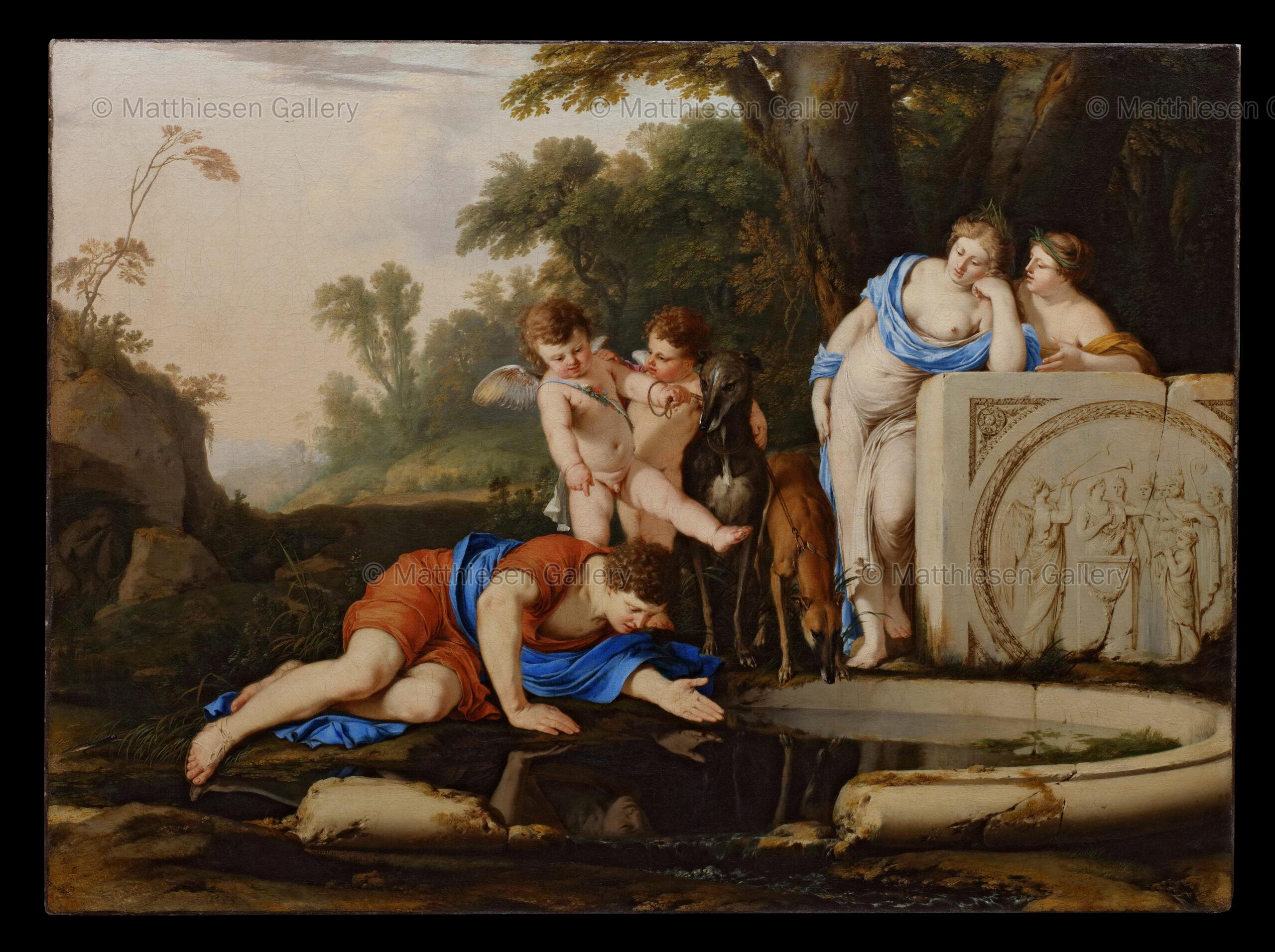
Celebrated in 1989-1990 with an exhibition organized by Jacques Thuillier and Pierre Rosenberg, Laurent de La Hyre continues to surprise us, the recent reappearance of several paintings, completing the image of an exceptional painter. This also allows us to understand the breadth of his creative spectrum, such as in his early works, The Defeat of the English on the Île de Ré by the French Army on November 8, 1627, acquired by the Musée de l’Armée (Invalides) in 2009, the large painting The Massacre of the Lapiths, which recently went on sale in France (Fig.1), to the painting dated 1639, The Blinding of the Inhabitants of Sodom, purchased by the Louvre in 2001, and this Narcissus from the 1640s, now in the Matthiesen Gallery.
The artist’s career was short since La Hyre died in 1656 at the age of only fifty, and the authors of the catalogue proposed dividing the painter’s career into four periods: from his early attempts to his first successes (1619-1630), the ‘Romantic period of Louis XIII (1630-1638)’, maturity (1629-1644) and the Atticism of the Regency, a concept dear to Jacques Thuillier, for the final years (1645-1656).
***
We consider it appropriate to cite ten of the artist’s creations illustrating his career and demonstrating his tireless curiosity and resourceful inventiveness. These are The Two Dogs, Arras Museum[1], from1632 (Fig.2), undoubtedly the most ‘Flemish’ painting in 17th-century French art; the thirteen drawings (Vienna, Albertina[2] Fig.3) based on Rubens’ paintings in the gallery dedicated to the life of Marie de Medici, then on display at the Luxembourg Palace. These demonstrate the interest of an artist in Rubens who would soon be at odds with Flemish art; Panthée conduite devant Cyrus (Montluçon, musée [3], Fig.4), a painting charmingly illustrating an episode from the tragic story of Abradate and Panthée as recounted by Xenophon and characteristic of the ‘romanticism’ of the Louis XIII period mentioned above; the May that La Hyre painted in 1637 for Notre-Dame de Paris, The Conversion of Saint Paul [4](Fig.5), undoubtedly one of the most baroque paintings of the period, along with that of Sébastien Bourdon for the same location but this vein did not last long for La Hyre; The Rape of Europa[5](Houston, The Museum of Fine Arts, Fig.6) from 1644, an expression of the artist’s classicism in this decisive decade. The painting was translated into tapestry for the tapestry series Les Amours des dieux (The Loves of the Gods), which also included the composition, Narcissus. The Vision of the Priest Lucien, a study in black chalk and squared (Paris, Louvre Museum[6] Fig.7), related to a tapestry of the story of Saint Stephen, certainly one of the artist’s most geometric and stripped-down drawings; The Allegory of the Regent Anne of Austria [7](1648, Palace of Versailles; Fig.8), The Allegory of Music [8](New York, The Metropolitan Museum ; Fig.9) from the series on the liberal arts painted for Gédéon Tallemant, master of requests and cousin of Tallemant des Réaux, in which the artist expresses a highly symbolic language with figures of intense realism;
the poignant representation of The Death of the Children of Bethel [9](musée d’Arras, Fig.10), a painting commissioned by Claude Héliot, advisor to the Court of Aids.
***
His work is therefore abundant and demonstrates a constant search for pictorial innovation, resulting in art of extreme ambition and refinement. La Hyre’s career was, all in all, that of a Parisian history painter who worked for churches, convents, as well as private individuals who were not necessarily members of the aristocracy.
The son of a painter, born not far from the Louvre, he is referred to as ‘painter to the King’ in a document dating from 1631[10] , married in January 1639, and had several children, including Philippe, a renowned scientist and mathematician.
The decisive factor for La Hyre was that he did not travel to Italy, because if he had made that journey, he would have evolved differently, more baroque, more lyrical perhaps, and might have developed along the lines of Domenichino and Pietro da Cortona whereas the Parisian Atticism that suited him so well was a consequence of Parisian culture. His art as a history painter consists of components around which almost all his painted work is organized: the science of composition, a rare balance between realism of the object and detail and idealisation of the figures, a sense of landscape and atmospheric effects, references to Antiquity (sculpture or architecture), and in this regard we might mention The Virgin and Child in the Louvre (1642)[11]. La Hyre’s main creations are completed by large landscapes that give his scenes a particular sense of grandeur, whether they are religious themes such as The Rest on the Flight of the Holy Family with Saint John and Four Angels (1646, Dresden[12]), Laban Searching for His Idols (1647, Paris, Louvre[13]) or subjects taken from such classical fables such as Narcissus.
He also painted smaller landscapes in which the historical subject matter of the painting recedes into the background, such as in a Landscape with Bathers (1653, Louvre)[14] or Landscape with a Swineherd (1648, Montréal)[15] which Charles Sterling included in the 1934 exhibition of the Painters of Reality, thus placing La Hyre in this realist movement that spanned the entire 17th century in France.
The admirable painting, Narcissus, presented here, must date from the early 1640s. We do not know who commissioned it, but we can imagine it was an art lover with a passion for landscapes and ancient literature; the format of the painting is that of a gallery painting. In width it is that of a ‘quadro d’imperatore per traverso’ a format that had been so successful since the beginning of the century. Antoine Schnapper[16] noted how little we know about the aficionados of ‘modern paintings’ whose names are given to us in a list of people published by J. Spon in 1673 or in artists’ biographies. For La Hyre these include Claude Heliot, advisor to the Court of Aids (already mentioned above), Mr. Petit, keeper of the king’s pendulums and mathematician, Mr. de Montgoubert, clerk of the king’s buildings, Mr. de Palerme, receiver general of the salt tax, Germain Roland, farmer general…
***
In the Narcissus, the landscape is extremely detailed, consisting of several layers with subtle gradations, perfectly balanced as is the entire composition, fading into the background while accompanying the subject. La Hyre paid close attention to Ovid’s text dedicated to Narcissus in Metamorphoses. Narcissus was a hunter, hence the presence of the two dogs held by cupids, and he neglected not only Echo, visible weeping in the cave on the left, but also the nymphs ‘born in the waters or on the mountains.’ In the painting, a nymph appears to be explaining to a melancholic nymph, whose head is resting on her hand, that Narcissus is a lost cause…….
‘Then someone he had despised […] cried out: “May he too love and never possess the object of his love.” The goddess of Rhammonte granted this just prayer. There was a clear spring whose waters sparkled like silver […]. All around stretched a lawn […] and a forest that prevented the sun from warming the atmosphere of the place. There the young man, tired from a strenuous hunt and the heat of the day, lay down on the ground […]. He wanted to quench his thirst, but he felt a new thirst rising within him. As he drank, enamoured of his image, which he sees in the water, he becomes passionate about an illusion without substance […]; he is entranced by himself […]. Lying on the ground, he contemplates his eyes, two stars, his hair worthy of Bacchus and no less worthy of Apollo, his smooth cheeks, his ivory neck, his graceful mouth, his complexion, which combines a ruddy glow with snow-white whiteness. Finally, he admires everything that makes him admirable. Without realising it, he desires himself; he is both the lover and the beloved, the object of his desires […]. Credulous child, why do you stubbornly try in vain to grasp a fleeting image? What you seek does not exist…’ (Ovid, Metamorphoses, III, 383-439[17]). Poor Narcissus, unable to detach himself from his image, no longer seeking sleep or food, will die and turn into a flower.
His hounds mirror the scene – one looks as if entranced at his reflection in the water while the other, with furrowed, enquiring brow, turns to his master looking askance.
‘Upon seeing his reflection in the clear water of the spring, Ovid’s hero falls victim to a double illusion – that of substituting the unreal for reality and mistaking one for the other,’ summarizes Françoise Frontisi-Ducroux in a pertinent phrase[18].
The artist, playing on the contrast between the light-skinned figures standing out against a dark background, has emphasized the expanse of water with its stone edge, which echoes the large bas-relief on which the two nymphs lean. The pictorial execution is as fascinating as the invention itself.
Refinement is evident in every detail. The reflection in the water of Narcissus’ face and hands, as well as the dogs’ paws, the cracks in the edge of the fountain through which water pours and the bas-relief, the delicacy of the bas-relief’s decoration, the careful drapery of the figures and the wings of the cupids, and the punctuating touches of bright blue. Everything takes place here, in the foreground, enclosed by the two cherubs, one of whom points at Narcissus, the two dogs, the two nymphs, and the large bas-relief. This is the main scene, Narcissus madly in love with his own image in the water, and the figures who exchange glances and seem to comment on the strange folly of the situation. Narcissus’ self-adulation makes him ignore the other figures and leads him to his doom. The figures remain still and the landscape serene despite the drama unfolding.
The subject of the imposing antique bas-relief depicts a scene that might to be construed to represent a celebration of the antithesis of narcissism. The moral that can be drawn from this scene is to say, ‘do not give in to vanity or pride, do not love yourself excessively, admire others instead, and remain humble.’ It has not yet been possible to identify the relief which may just be pure invention.[19] The group depicted stands near an altar where flames are visible. To the left, we see the winged figure of Fame blowing a double trumpet while in the centre, behind the altar, a figure crowned with ears of corn or laurel holds a horn- or sickle-shaped object in one hand and reaches out with the other toward a man wearing a helmet and antique armour. The figures accompanying them are also crowned (with ears of corn or laurel?). In the foreground on the right, a child plays the flute.
***
The word ‘Atticism’ has often been used in relation to La Hyre’s work. Proposed by Bernard Dorival, the definition of the classical influence on the painting of several Parisian artists between 1645 and 1660 was taken up and developed by Jacques Thuillier, and characterised as follows by Pierre Rosenberg[20], who rightly quotes two of the painter’s contemporaries, born, like him, after 1600: ‘These artists [including Champaigne, La Hyre, and Le Sueur] favour a smooth style, without marked impasto, light colours juxtaposed with refined audacity, sometimes with a touch of preciousness, and skilful modelling. They favour line over colour, shun movement, and attach great importance to rigorous composition […] Increasing rigor, uncompromising austerity, and stylisation pushed to its extreme, sometimes close to neoclassicism, sometimes to ‘Ingresianism’, replace the joyful sensuality of their early works, their refined elegance, and their distinctly decorative style.’
Indeed, when we compare The Rape of Europa [21], painted by La Hyre in 1644, with one painted by Simon Vouet (1590-1649) a little earlier, probably around 1641-1642 (the painting [22] was engraved by Michel Dorigny in 1642) we understand what sets the two artists apart. Vouet’s painting (Fig.11) is constructed around figures in motion, linked to one another by their gestures. Europe is unbalanced on the bull, and the background consists of foliage and an opening to the sky, while La Hyre’s painting shows sculptural figures. Europa’s companions carefully placing her on the bull, Europa’s head in profile standing out against a background of carefully painted rocks. Where the artists undoubtedly converge is in their mastery of drapery and colour, making spectacular use of the three fundamental colours of yellow, blue, and red.
The composition of La Hyre’s The Abduction of Europa, which must have been created around the same time as Narcissus, was woven (Fig.12) in the same series as the latter (Fig.13), in the Faubourg Saint-Marcel in Paris around the middle of the century.
A tapestry, made of wool and silk embellished with gold, is mentioned in the royal inventory of 1673 under the name Amours des dieux (The Loves of the Gods), without the titles of each of the compositions, but, as Maurice Fenaille (1, 1903, pp. 349-352), the common denominator is indeed the illustration of episodes from the fable. The royal suite was purchased in 1663 from Sieur Foucanié (an associate of Comans) and has been lost. The series is known today through numerous woven editions, including the five pieces from the former Brosselin collection belonging to the Mobilier National.[23], The tapestry also includes Glaucus and Scylla, in reference to a painting kept in Los Angeles, (The J.P. Getty Museum[24], Fig.14), Meleager and Atalanta,[25] Cephalus and Procris, [26] Pygmalion and Galatea [27] and in a completely different format, Diane’s Repose[28] dated 1649 (Fig.15). As Jean Vittet noted [29], the HC monogram found on several pieces shows that the tapestries were woven specifically in the workshop of Hippolyte de Comans, the director of the Faubourg Saint-Marcel factory since 1650. In accordance with a fairly common practice in the 17th century, the paintings were undoubtedly used to produce careful copies, which were then used to create the cartoons needed for weaving. There are few differences between the paintings and the tapestry, apart from a more compact format. Three main border designs have been identified on the Parisian weavings.[30]. At a time when Rinaldo and Armida‘s tapestry based on Simon Vouet was still enjoying success, La Hyre’s tapestries of the gods conveyed a different type of composition, more legible, forming a homogeneous, monumental series, nourished by references to antiquity in keeping with the new taste.
A.B. L
[1] Grenoble-Rennes-Bordeaux, 1989-1990, n° 75.
[2] Grenoble-Rennes-Bordeaux, 1989-1990, n° 85- 97.
[3] Grenoble-Rennes-Bordeaux, 1989-1990, n°101.
[4] Grenoble-Rennes-Bordeaux, 1989-1990, n°136.
[5] Grenoble-Rennes-Bordeaux, 1989-1990, n°203.
[6] Inv. 27513 ; [6] Grenoble-Rennes-Bordeaux, 1989-1990, n°225.
[7] Grenoble-Rennes-Bordeaux, 1989-1990, n°249.
[8] Grenoble-Rennes-Bordeaux, 1989-1990, n°259.
[9] Grenoble-Rennes-Bordeaux, 1989-1990, n°313.
[10] Grenoble-Rennes-Bordeaux, 1989-1990, p. 86.
[11] Grenoble-Rennes-Bordeaux, 1989-1990, n°193.
[12] Grenoble-Rennes-Bordeaux, 1989-1990, n°232.
[13] Grenoble-Rennes-Bordeaux, 1989-1990, n°235.
[14] Grenoble-Rennes-Bordeaux, 1989-1990, n°314.
[15] Grenoble-Rennes-Bordeaux, 1989-1990, n°240.
[16] Curieux du Grand Siècle, collections et collectionneurs dans la France du XVIIe siècle, Paris, Flammarion, 1994, p. 36.
[17] Edition of Jean-Pierre Néraudau, Gallimard, classical folio, p. 119-120.
[18] Cited by Alina-Daniela Marinescu, ‘Les métamorphoses textuelles du mythe de Narcisse dans le moyen âge français : mise en abyme, parodie et commentaire’, Carnets, revue électronique d’Etudes françaises, Association Portugaise d’Etudes françaises, first series, 5/2013, p. 51-61, OpenEdition Journals, https:// doi.org/10. 4000/ carnets.8200.
[19] Beverly Brown and Jennifer Montagu lean towards invention.
[20] In the exhibition catalogue La peinture française du XVIIe siècle dans les collections américaines, Paris-New York-Chicago, 1982, p. 145-146, cited by Alain Mérot, ‘L’atticisme parisien : réflexions sur un style’ in the exhibition catalogue Eloge de la clarté, Un courant artistique au temps de Mazarin 1640-1660, Dijon-Le Mans, 1998-1999, p.14.
[21] Signed and dated painting 1644, Houston, The Museum of Fine Arts, inv. 70-12 ; Grenoble-Rennes-Bordeaux, 1989-1990, p. 244, n°203.
[22] Madrid, Thyssen-Bornemisza National Museum, exhibition catalogue Vouet, Paris, Galeries nationales du Grand Palais, 1990-1991, p. 320, n°55 (by Jacques Thuillier).
[23] Inv. GOB 867/1-5.see Un temps d’exubérance, Les arts décoratifs sous Louis XIII et Anne d’Autriche, exh. Cat.,Paris, Grand Palais, 2002 p. 172,n°99 For further copies, see Grenoble-Rennes-Bordeaux, 1989-1990, p.240-241
[24] Grenoble-Rennes-Bordeaux, 1989-1990, p.241, n°198.
[25] No drawings or paintings preserved.
[26] Painting lost but the preparatory drawing is in New York, The Metropolitan Museum, Fletcher Fund, inv. 1972. 224-4, Grenoble-Rennes-Bordeaux, 1989-1990, p.242, n°200.
[27] See the exhibition catalogue Un temps d’exubérance, Les arts décoratifs sous Louis XIII et Anne d’Autriche, Paris, Grand Palais, 2002 p. 172, n°99 (note by Jean Vittet, who also mentions two different versions of Meleager and Atalanta for this series).
[28] Painting dated and signed 1649, Moscow, Tropinin Museum, former collection of Felix Vishnevsky, Grenoble-Rennes-Bordeaux, 1989-1990, p.286, n°250.
[29] See note 24.
[30] See note 24.
Horace Walpole (?);
Robert Walpole, First Duke of Orford. Laurent de la Hyre – Narcissus, 13 pounds, His Sale, lot 44, (2nd Day)[1]. Buyer, Kellaway;
Lt.Col. Bernard Granville, Chadley House, Wellesbourne, Warwickshire;[2]
The Ednam Sale Christies 19th of July 1929, n.111, Stock number 543EZ as by Robert Lefevre for 42 Guinee’s; Bought by H.A. Vokins; presumed to be Herbert Arthur Vokins;[3]
Pietro Accorsi, Turin?
Paolo Casalotto Cossu, Turin by 1958;
Brun Fine Art Brussels and Milan;
Artcurial, Paris, 9th of November 2022 lot.108 (sale subsequently cancelled);[4]
Brun Fine Art, Milan;
Matthiesen Gallery, London, June 2024.
[1] Getty Provenance Index Br-A415. Kellaway bought one other lot, a Saint Francis by Annibale Carracci, (I am indebted to Lucy Speelman for confirmation of research on provenance).
[2] He gained the rank of Lieutenant-Colonel in the Warwickshire Yeomanry, and of Lieutenant-Colonel in the 3rd Hussars. Fought in the Boer War, South Africa. He held the office of Deputy Lieutenant (D.L.) and Justice of the Peace (J.P.).
[3] Arthur Vokins (1839-1913), son of John Henry Vokins, worked as a picture restorer as well as a dealer. He held an account with the artists’ suppliers, Roberson’s, from 23 Baker St in 1894 (Woodcock 1997). A. Vokins & Sons were trading from Holborn in 1915 as picture liners, restorers and cleaners, while Arthur’s son, Herbert Arthur Vokins (1868-1930) was trading from 22 South Molton St in 1915 as a picture liner, restorer and cleaner. Pawsey & Payne. Payne had been a manager at Vokins (information from Briony Llewellyn, September 2019). Vokins’ records were lost in the Second World War because of bomb damage to Pawsey & Payne’s building in Bury St, St James’s (information supplied by a former partner in the business to Briony Llewellyn, September 2008).
[4] The painting appeared at Artcurial in its prewar frame, but with a gilt plaque inscribed ‘Robert Lefevre, Scuola Italiana’. This led to the conclusion that the painting had been consigned from Italy, without an export licence, rather than, as Artcurial brazenly continued to maintain that it had been in ‘a Brussels bourgeois family for a couple of generations.’ In depth investigation over more than a year and collaboration with the Rome carabinieri eventually led to a photo of the painting hanging in a Turin apartment. Further enquiries ascertained that the painting had left Italy only a couple of months before the sale. The painting was repatriated and subsequently an export licence was granted.
Rosenberg and Thuillier in Grenoble-Rennes-Bordeaux, 1989-1990, p. 242, no. 199 (listed as lost, the painting reproduced from the 1929 sale catalogue has the same dimensions and is identical in every respect to the painting studied here, but the latter is unsigned, whereas the painting from the 1929 sale was said to be signed Lebrun)[1].
Vincent Noce, ‘Laurent de la Hyre, la tuile’, Gazette del’Hotel Drouot, No.13, 31 March 2023.
Eileen Kinsella, https://artnet.com/about/eileen kinsella-22 May 30th 2023 ‘What the Story of a Botched $1 Million Auction Sale Reveals about the clash between New Anti-Money Laundering [AML] laws and client confidentiality.’
‘Artcurial cancels the sale over provenance row with dealer,’ The Art Newspaper, No.356, May 2023.
INSCRIPTION: On the reverse of the original canvas are some letters with symbols and possibly numbers.
[1] It is so described in the Christie’s catalogue and on a very old photographic file dating from the period in the Witt Library, London.