
Clytemnestra and Agamemnon(Baron Pierre-Narcisse Guerin)
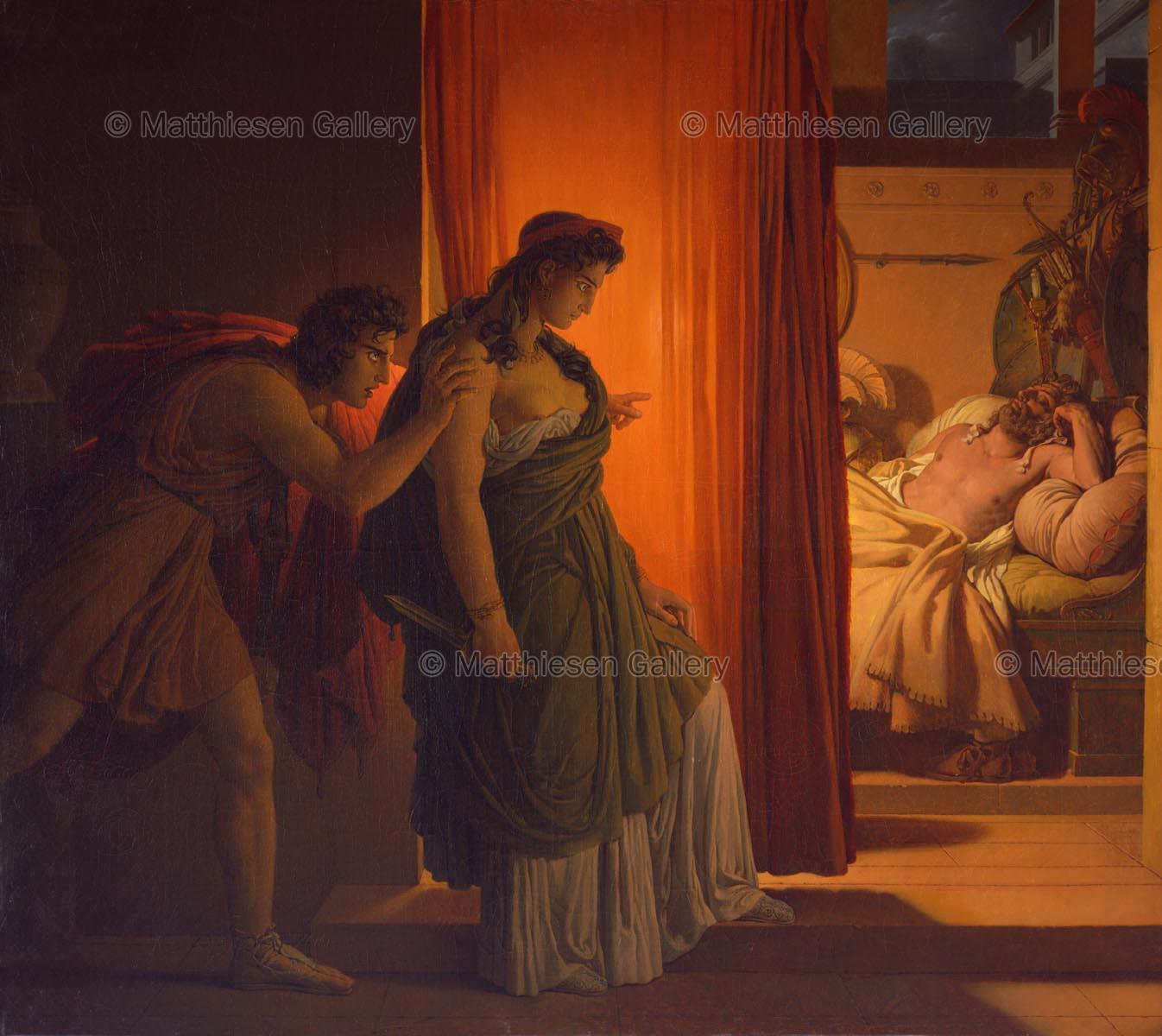
Acquired by the Smith College Art Museum
Guérin may be considered one of the leaders of the neoclassical movement which, led by Vien and then his pupil David, reached its apogee at the turn of the eighteenth century. From a young age his artistic career was encouraged by his parents, his precocious beginnings accorded him early success. He first entered the studio of Brenet and continued his studies with Regnault. In 1797 at the age of twenty-three, Guérin won first prize in the coveted Prix de Rome. The Return of Marcus Sextus , considered one of his masterpieces, was painted two years later in 1799, establishing his reputation as a leading painter of the neoclassical school. By 1814 he was a master at the École des Beaux-Arts. Although he initially refused the directorship of the Academy in Rome, he accepted the position in 1822. In 1829 he was elevated by the King to the rank of Baron like his near contemporaries Gros and Gérard. As a teacher he moved away from academic neoclassicism and it is no surprise that among his most renowned romantic students were Géricault, Delacroix, and Scheffer.
Our painting, which recalls the work of Fuseli as well as David, depicts the moment when Clytemnestra is about to murder her unsuspecting husband Agamemnon with the aide of her lover Aegisthis. Agamemnon, King of Mycenae, had already murdered Clytemenstras first husband, Tantalus, and their baby daughter. Later, after favorably comparing his own prowess as a hunter with that of Artemis, the Goddess becalmed his ships on route to Troy. Told that only the sacrifice of his eldest daughter by Clytemnestra, Iphigenia, would satisfy the angry Artemis, he resolved to kill her. Fortunately she escaped her fate when Artemis substituted her with a stag.
Nonetheless, this aggravated the hatred already felt by Clytemenstra. While he was away at the Trojan wars she took a lover, and resolved to murder her husband when she learnt of his intention to bring home Priams daughter, Cassandra, as his concubine. Homer tells the tale as a massacre of Agamemnons followers by an armed gang led by Aegisthis, but Aeschylus sets the scene in the Kings chamber while he bathes. In Guérins composition, Agamemnon slumbers, his weapons laid out beside him, unaware of his imminent death while his assassins creep into his room. Guérin employs a rich palette of burnt orange and crimson to highlight the partially drawn curtain aglow with candlelight. The painting was possibly exhibited in the Salon of 1822.
Exhibited: Salon of 1822 (?)
Related Works: Louvre, 1817, oil on canvas: 3.12 x 3.25 meters, exhibited Paris Salon, 1817.