
Allegory of Poetry(Eustache Le Sueur)
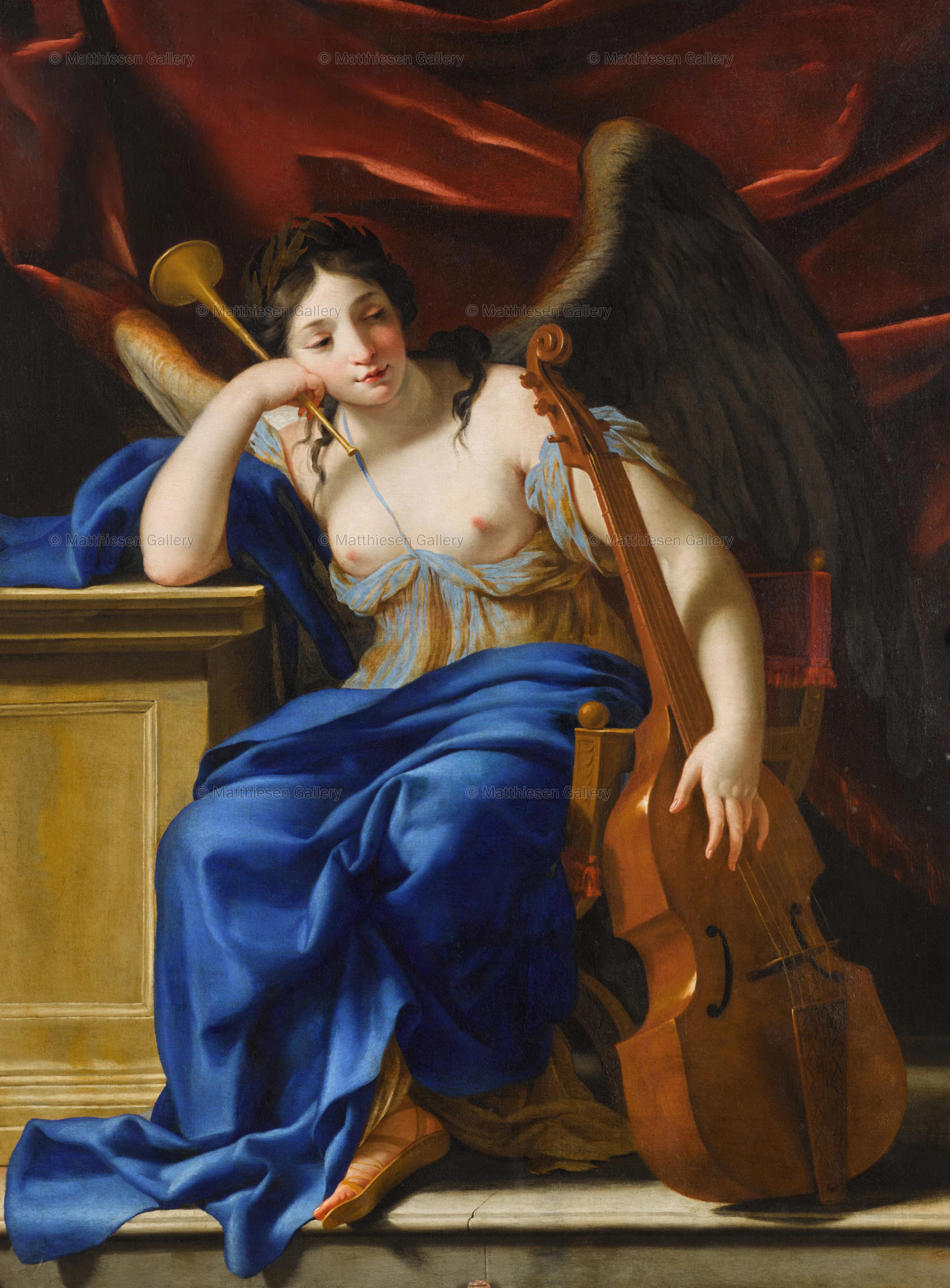
A striking masterpiece by the young Eustache Le Sueur, the Allegory of Poetry is an elegant composition displaying the influence of this master Simon Vouet (1590-1649). Datable to the early 1640s when his career as an independent artist in Paris was flourishing, this work exhibits the development of his own accomplished style that would soon establish him as one of the most important painters of the seventeenth century France and a leading proponent of Parisian Atticism. Rediscovered in 2009, after having been in the same family collection for generations and unknown to scholars, the painting was found to have hung at the renowned Hotel Lambert in the eighteenth century, and was likely commissioned directly from Le Sueur by the Lambert family to decorate their residence.
Sienese Raffaello Vanni (1587-1673), and lastly, a grand Poultry Market by Adriaen van Utrecht (1599-1652), for which he paid £1500 in the belief that it was by Rubens. These and the Dandinis were probably all purchased through (and perhaps on the advice of) his agent in Livorno, the Huguenot Anthony Lefroy (1703-1779). Dashwood’s importance as a collector and connoisseur was, however, ultimately overshadowed by his notoriety. His political career did little to enhance his reputation: its apogee, his very brief stint as Chancellor of the Exchequer in 1762-63, led to riots when he imposed a tax upon cider.
After their sale from West Wycombe Park in 1986, these canvases formed part of the distinguished collection of another celebrated collector, the famous American interior designer Victoria Press (1927-2015). They were hung in another famous eighteenth-century interior, that of Press’s London town house at no. 4 Cheyne Walk in Chelsea, a five-storey Queen Anne House originally built 1717 where the writer George Eliot had briefly lived and died in 1880, which she and her husband the South African business magnate Sydney Press acquired in 1982 (fig.4). Press had originally studied fashion under Claire McCardell before turning to interior decoration, successfully combining the two disciplines into a uniquely personal aesthetic vision. A ‘self-taught aesthete and connoisseur’, she became highly knowledgeable in the fields of English furniture and ceramics, and her colleciton of Chinese blanc de Chine porcelain became one of the finest in private hands.
The Hotel Lambert sits at the eastern tip of the Ile Saint-Louis on the river Seine in Paris (fig.1). Built between 1640 and 1644, it was designed by the architect Louis Le Vau (1612-1670) for the financier Jean-Baptiste Lambert (1608-1644). After Lambert’s death in December 1644- only about eight months after moving into the residence- his younger brother Nicolas Lambert de Thorigny (1613-1692) inherited the property and concinued with its construction. It was Nicolas Lambert de Thorigny (1613-1692) inherited the property and concinued with its construction. It was Nicolas who commissioned most of the magnificent interior decoration, executed by the most famous French painters of the time, including Charles Le Brun (1619-1690), Francois Perrier (1590-1649) and Eustache Le Sueur, who in around 1646-47 executed a series of impressive canvases now in the Louvre, Paris. The subjects of their compositions explore themes relating to love and mythology, creating an innovative and coherent interior design that complemented the 17th century architecture. After Nicolas’s death, the residence passed by descent in his family until 1732. After that, it belonged to various owners, including Emilie du Chatelet (1706-1749), Voltaire’s mistress, who sold it in 1745 to Marin Delahaye (1648-1753). Upon Delahaye’s death in 1753, his brother Marc- Antoine Delahaye de Bazinville (1702-1785) inherited the property, and it is his direct descendants who in 2009 sold the Allegory of Poetry, having held it in the same family’s ownership for more than two and a half centuries.
The painting is first recorded in a document annexed to a deed of sale for the Hotel Lambert dated 31 March 1739, where it is listed as an overdoor in the ‘Grand Cabinet’, a room that led to the ‘Cabinet de l’ Amour’ in the state apartments. While there are no records of the painting before this date, the earlier inventories of the Hotel do not include the paintings that were inserted into elements of the decor, such as panelling, overdoors and ceilings, which likely accounts for its omission. The Allegory of Poetry is next recorded in an inventory dated 13 October 1753, where it is listed as Music in the form of a winged woman. This discrepancy is likely due to the presence of the trumpet and viola da gamba- the latter being a popular instrument in 17th- century France- although in fact the attributes of the figure in the present painting correspond directly with those of the allegorical figure of Poetry as described in Cesare Ripa’s Iconologia of 1593, an influential emblem book that inspired many artists of the day. Common to both is the laurel wreath, blue robe and bare breast, as well as the stringed instrument and trumpet.
The present wark was not invluded in the posthumous sale of Martin Delahe’s paintings held in 1754, nor in his widow’s sale of 1778 but was kept by his brother Marc- Antoine Delahaye de Bazinville. It was subsequently inherited by his daughter, Antoinette Marguerite Joseph Delahaye de Bazinville (1733-1813) who brought it first to the Hotel Fieubet, near the Ile Saint- Louis but on the right bank, and then in 1813 to her chateau, near Paris, where it was rediscovered almost two centuries later. Although the painting was unknown to Alain Merot when he published his 1987 catalogue raisonne on the artist, he has subsequently endorsed its attribution.
Stilistically this painting shows a number of similarities to The Triumph of Galatea, which sold in these Rooms in 2007. Datable to around to c. 1643, close comparison can be made between the female protanosists in each painting, particularly in the facial features which suggest they were both based on the same model (fig. 4). Somewhat unusually for a French artist of his stature, Le Sueur never left Paris for a tour of Italy but in 1632 was accepted into the studio of Vouet, who had returned from Rome in 1627. Le Sueur embraced the richness and sensuality of Vouet’s paintings, while also developing a classical elegance and harmony in his work. By the 1640s, Le Sueur was fully established as one of the city’s leading painters. In 1648 hhe was one of the twelve founding members of the Academie royale de peinture and he was appointed Peintre Ordinaire du Roi in 1649. His illustrious career was tragically cut short by his early death in 1655 at the age of just thirty-eight.