


Page 24 - Francis Cotes - A winning end-game
P. 24
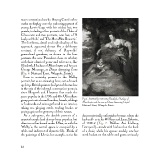
more conventional works. Among Cotes’s other        Fig 6. JOSHUA REYNOLDS, Elizabeth, Duchess of
works on display were the endearing portrait of     Manchester and her son as Diana disarming Cupid,
young Lewis Cage with his cricket bat; two          National Trust, Wimpole Estate.
pastels, including a fine portrait of the Duke of
Gloucester and two portraits, now lost, of ‘A       characteristically unfurnished rooms, where the
Lady as Hebe’ and ‘The Hon Mrs Bouverie’.           husband - as in his William and Lucy Atherton,
The liveliness, detail and individuality of his     of 1742-4 (Fig. 7. Walker Art Gallery,
approach, appeared almost like a deliberate         Liverpool) - stands with his hand on the back
contrast, if not defiance, of Reynolds’             of a chair, while his spouse meekly sets her
generalised grandeur, as shown in the four          work basket on the table and gazes seriously
portraits the new President chose to exhibit,
with their classical poses and references, like
Elizabeth, Duchess of Manchester and her son
George Montagu, as Diana disarming Love
(Fig. 6. National Trust, Wimpole Estate).

 Love is certainly present in the Welby
portrait, but as an animating force, not a dressed
up deity. British painters had proved themselves
in the vein of the informal conversation portrait,
since Hogarth and Hayman first made the
genre popular in the 1730s and 40s. Often these
group portraits showed families, friends, siblings
or husbands and wives gathered in an interior,
taking tea, playing cards, reading books, or
posing against the greenery of their estates.

 As a sub-genre, the double portrait of a
married couple had always been popular, but
often in a rather formal mode. Often, as with the
Welby’s, the central space is occupied by a
table, and indicator of domestic life. Think of
the paintings of Devis, for example, set in his

24

