


Page 54 - GUIDO RENI 2017
P. 54
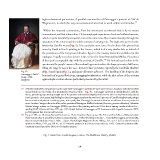
high ecclesiastical portraiture. A parallel case was that of Caravaggio’s portrait of Olaf de
                     Wignacourt, in which this very unconventional artist had to work within set formulae.17

Fig. 4b.             Within the imposed conventions, Reni has introduced an element that is by no means
Caravaggio, Paul V.  conventional, and that is the colour. He has employed a spectrum of reds and suffused mauves,
Rome, Villa          which is quite beautifully tempered, but at the same time this creates intensity through the
Borghese.            saturation of the colours and the subtle contrast of varying reds. The highest keyed red is the
                     beretta that Camillo wears (Fig. 4). It is exactly the same tone of red as that of the plumed hat
                     worn by David in Reni’s painting in the Louvre, which is of a very similar date or indeed of
                     the pantaloons of the foreground drunken figure in the Country Dance also published in this
                     catalogue. Equally very close in tone is the red used in Saints Peter and Paul (Milan, Pinacoteca
                     di Brera) of a comparable date with the portrait of Camillo.18 The lowest keyed colour in the
                     spectrum is the purple-mauve of the cardinal’s garments where the drapery is cast in half tones,
                     filling the range between the two. In Reni’s later portraits, especially the Cardinals Ubaldini
                     (Fig. 3) and Spada (Fig. 1), analogous effects are achieved. The handling of the drapery also
                     betrays Reni’s typical fluttering, zigzagging brushstrokes, while the shot colour of the curtains
                     again adopts a colour scheme particularly favoured by the artist.

17	 A further instructive comparison may be made with Caravaggio’s portrait of Pope Paul V (Rome, Borghese collection) which
     was probably executed only a few months after Reni’s portrait – Fig. 4b. Caravaggio’s portrait is equally hieratic, with the
     fierce, pursed lip pope staring straight out of the picture with his head slightly turned to the left in a way that closely echoes
     Reni’s portrait. One cannot help feeling but that Caravaggio must have known Reni’s portrait of Camillo Borghese and perhaps
     his commission stipulated a matching pose, and equally that Caravaggio’s natural inclination would have been to produce a
     more ‘modern’ image in the vein of his earlier portrait of Monsignor Maffeo Barberini (Florence, private collection). Sebastian
     Schutze’s large volume on Caravaggio (2009) reproduced the painting under no.76 but lists it among ‘works attributed to’,
     quoting Kruft’s (Storia dell’Arte,1991, pp. 184-6)) and Solinas’s (Caravaggio nel IV Centennario della Cappella Contarini, 2002,
     p.244) opinion that it is instead by Leoni.

18	 Pepper 1984, no. 18, Saints Peter and Paul; and no. 19, for David; but Spear opines ‘Sts. Peter and Paul’ (Brera, Milan) of which
     I have written that ‘it would be prudent to await cleaning ... before deciding on its date ...I nonetheless suggest, provisionally,
     that it is considerably later than c. 1605 ... Spear, The Burlington Magazine CXXXI, 1989, p.371, no.12. See too Daniele Banti’s
     opinion in Milan, 1991, pp.238-41, no.119 that the picture in the Brera is later than ca. 1605. Catherine Johnston (Ms.
     communication September 2016) is of a similar opinion.

                     Fig. 5. Guido Reni, Camillo Borghese, London, The Matthiesen Gallery, (detail).

                     54

