


Page 18 - GUIDO RENI 2017
P. 18
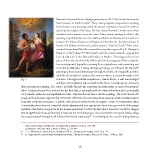
Sementi had joined Guido’s bottega quite early in 1612. Both artists became the
         best imitators of Guido’s style8. They often prepared compositions working

         from Guido’s own drawings which the master only had to retouch in order to

         speed up the output of the shop. For this reason Sementi’s works were often

         mistaken as the master’s as in the case of the present painting. In effect, this

         painting is probably the one recorded by Charles de Brosses in his Letters as

         being in the Palazzo Ranuzzi in Bologna and described as ‘Joseph tenté par la
         femme de Potiphar, de Sementi, aussi beau que s’il était de Guide’9 After some

         research it was found that the composition was also engraved by R. Strange in
         Naples in 1762 (‘Atque Ao.1769 incidit’) with the citation that the original had

         been at that time in the Baronelli Palace in Naples. This triggered a serious

         piece of detective work worthy of Hercule Poirot as it appeared there might be

         two paintings and, logically, a missing Reni original since such a painting was

         recorded by Malvasia. Tracing through genealogy we followed the Baronelli

         painting by descent and inheritance through the Ruffo, the Pignatelli and then

         with the Sezza until we came to the current owner, a certain Riccardo Tosti

Fig. 4.  in Rome. Through a mutual acquaintence, Bianca Riccio, a visit was arranged

         and there unrecognised, unloved and on the floor, I was shown an extremely

dirty anonymous painting. The owner had little knowledge regarding its authenticity or indeed its intrinsic

value. Being an honest fool, and not for the first time, I promptly told the owners that they had a potentially

very valuable authentic and unpublished Guido. That was the last time I saw the painting. The next I heard of it

Joseph and Potiphar had reappeared in 1993 in the collection of a noted American museum, mysteriously acquired

from that catch-all provenance, ‘a private collection across the border in Lugano’. I have to confess that, when

I eventually saw it cleaned, I was just a little disappointed as it appeared to have lost a great deal of the magic

and allure that had been apparent in the Roman apartment. Not for the first time I learned to my bitter chagrin

that straightforwardness and honesty in business does not always pay. It seems that the concept of noblesse oblige
has not percolated through to all levels of the Italian aristocracy10. Art dealing can be a very bruising business

     Reni, Emilio Negro and Massimo Pirondini [Ed.], Modena 1992, p. 327-342.
	 and Massimo Pirondini [Ed.], Modena 1992, p. 327-342.
8.	 C. C. Malvasia, La Felsina Pittrice, Bologna 1678, G. Zanotti (ed.) Bologna, 1841, II, p. 73.
9.	 Le Temps retrouvé: Lettres d’Italie du Président de Brosses, Charles de Brosses, Mercure de France, 1986, p. 280.

         18

